

Introduction
If you installed a rooftop solar system in the last few years or you are planning to get one soon then the shift from net metering to net billing is something you really cannot afford to ignore. India's electricity regulations have been changing quietly but the impact on your monthly savings and long-term solar return on investment is anything but quiet.
The central government along with several state electricity regulatory commissions has been pushing toward net billing as the default framework for new rooftop solar connections in 2025-26. For homeowners farmers and small business owners who depend on solar to cut electricity costs this change is significant.
At Aatmanirbhar Solar we have been closely tracking these policy updates and we want to break this down in a way that actually helps you make smarter decisions.
What is Net Metering and Why Did People Love It
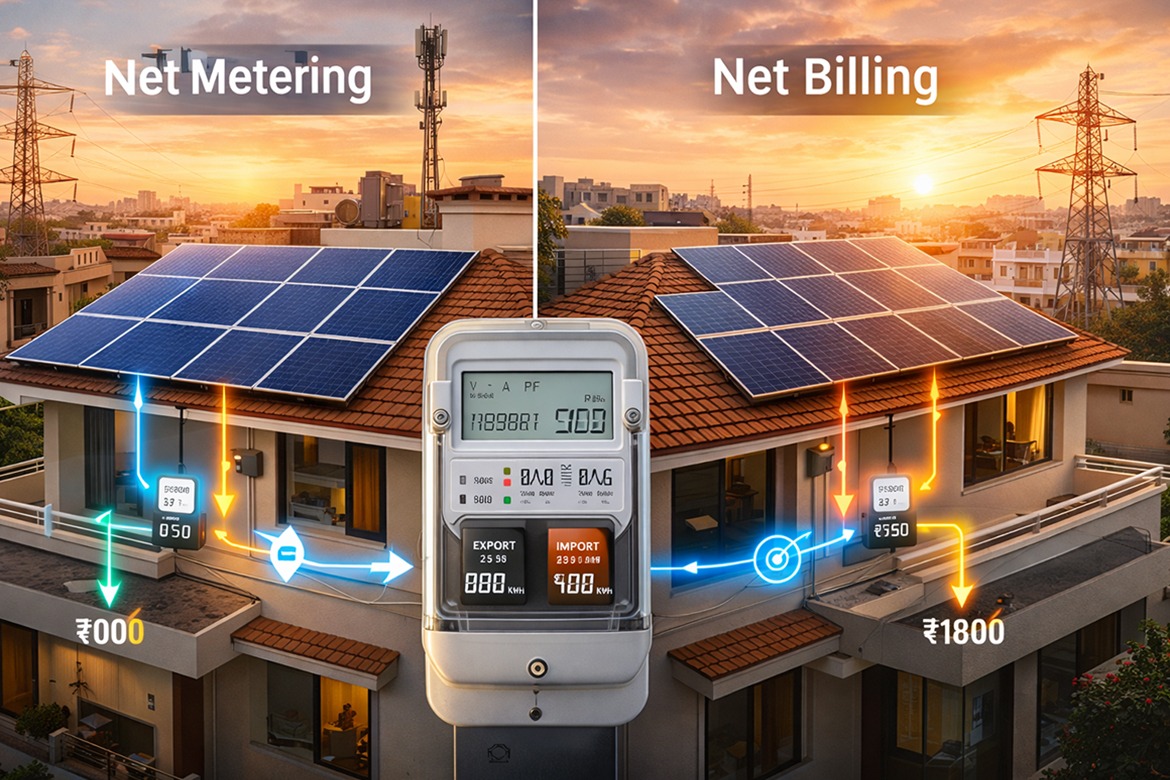
Under net metering your solar system feeds surplus electricity back into the grid and for every unit you export you get a credit equal to the retail electricity rate. So if your tariff is Rs 6 per unit and you export 100 units in a month you get a Rs 600 credit on your bill.
It was straightforward and it made the payback period on solar panels much shorter. For most Indian households net metering was the single biggest financial reason to go solar beyond the PM Surya Ghar subsidy.
What is Net Billing and How is It Different
Net billing works differently. You still send surplus power back to the grid but instead of getting the retail rate you only get the APPC which stands for Average Power Purchase Cost. This is the rate at which the distribution company buys power from generators in bulk.
Depending on your state this APPC rate can be anywhere between Rs 2.50 to Rs 4 per unit which is significantly lower than what you pay for electricity. The gap between what you export and what you import is where your savings shrink.
How This Affects Your Solar ROI in Real Numbers
Let us say you have a 5 kW rooftop system and you export around 150 units every month. Under net metering at Rs 6 per unit that is a Rs 900 monthly credit. Under net billing at Rs 3 per unit that same 150 units gives you only Rs 450.
Over a year that is a difference of Rs 5400 and over the typical 25-year life of a solar panel the financial impact is substantial. Your payback period under net billing can increase by 2 to 4 years depending on your state tariff and export volume.
States Where Net Billing is Already in Effect or Being Rolled Out
Gujarat Rajasthan Karnataka and several other states have already begun transitioning new solar connections to net billing or hybrid models.
If you are in a state where net metering is still active for residential connections above a certain capacity then getting your system installed and approved before any regulatory change in your area becomes a priority worth acting on now.
What You Can Do to Maximize Your Returns Despite the Policy Shift
The single most effective strategy is to reduce how much surplus power you send back to the grid. This means sizing your solar system accurately based on your actual consumption rather than oversizing it.
Using high-efficiency panels like the Uranus and Neptune series from Aatmanirbhar Solar ensures that you generate more usable power per square foot without unnecessary surplus. Adding a battery storage system if your budget allows helps you store the extra generation and use it at night instead of exporting it at a lower rate.
Time-shifting your heavy loads like washing machines, air conditioners and water pumps to peak solar hours is another low-cost habit that dramatically improves your self-consumption ratio.
Why Panel Quality Matters More Than Ever Under Net Billing
When your financial return depends more on how much solar power you actually consume rather than how much you export to the grid the efficiency and reliability of your panels become central to your ROI.
A lower-efficiency panel might cost less upfront but it will generate less usable power and push more of your consumption back to the grid at full retail rates.
Aatmanirbhar Solar manufactures mono PERC half-cut cell modules certified under BIS IEC and ISO 9001 standards which means you get consistent high output across Indian weather conditions from coastal humidity to dry Gujarat summers.
Understanding the PM Surya Ghar Muft Bijli Yojana in This Context
The PM Surya Ghar scheme provides subsidies of up to Rs 78000 for residential rooftop solar and is still one of the strongest financial incentives available. However the subsidy is tied to grid-connected systems and the billing framework your DISCOM applies post-connection depends on your state policy.
Applying under this scheme before net billing becomes mandatory in your area locks in better economics from day one.
Conclusion
The shift from net metering to net billing is not a reason to avoid solar but it is absolutely a reason to be more strategic about how you go solar.
Choosing the right system size working with a manufacturer that delivers genuine efficiency and making the move before your state completes its transition can protect your returns significantly.
At Aatmanirbhar Solar our goal has always been to make solar accessible and genuinely profitable for every Indian household and business. Whether you are in Gujarat or anywhere across India our team can help you design a system that works in your favor even under the new billing rules.
Reach out to us at aatmanirbharsolar.com and let us build your energy future the right way.