

Introduction
Walk into any solar showroom in India today and within five minutes someone will throw the words TOPCon and PERC at you like you are supposed to already know what they mean and which one to pick. Most buyers nod along and then go home more confused than when they walked in.
Here is the thing though. This is not a complicated decision once you strip away the jargon. The technology gap between TOPCon and PERC is real but whether that gap matters for your home, your farm or your factory depends entirely on your specific situation. Not on what is trending on YouTube or what the salesperson gets a better margin on.
At Aatmanirbhar Solar we produce both technologies at our Gujarat facility and we have seen enough real installations across India to tell you what actually moves the needle and what is just marketing noise.
1. The Core Difference Is Not Just Efficiency Numbers
Most comparisons between TOPCon and PERC lead with efficiency percentages and stop there. PERC gives you roughly 19 to 21 percent.
TOPCon pushes that to 22 to 24 percent. Fine. But what does that actually mean on your rooftop on a Tuesday afternoon in May when the temperature is sitting at 43 degrees?
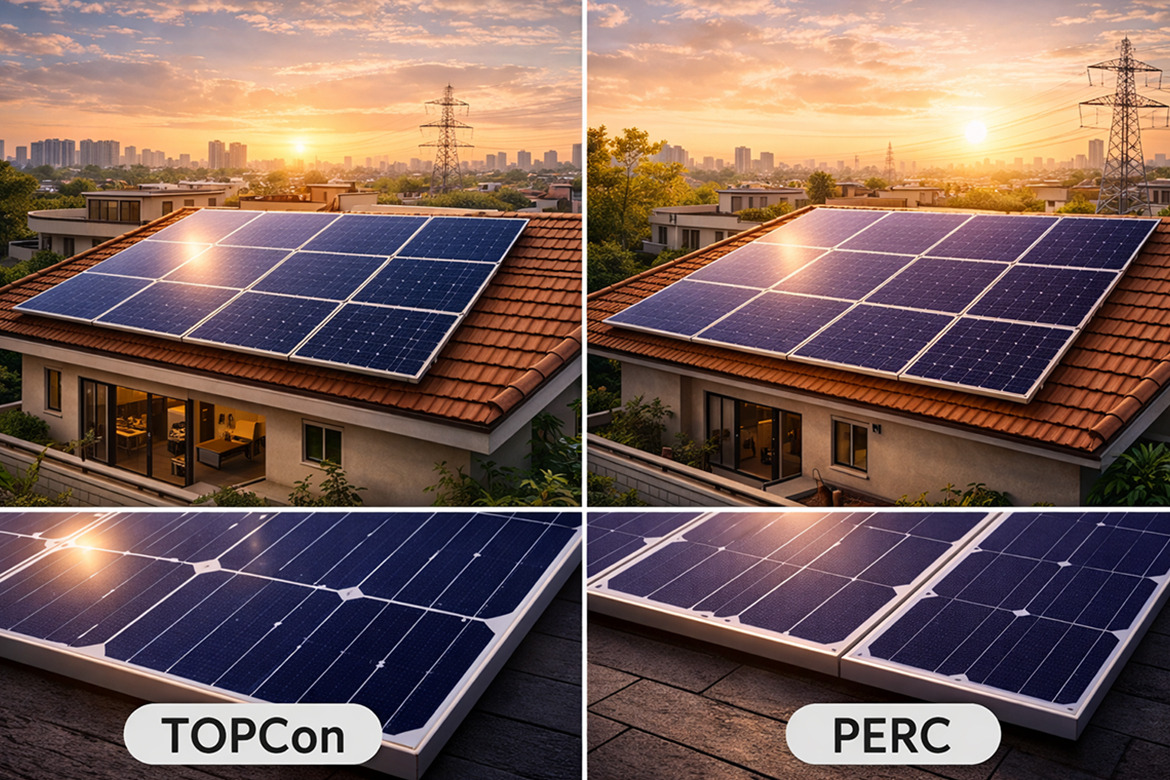
PERC panels work by bouncing unabsorbed light back through the cell using a reflective rear layer. It was a genuine leap forward when it arrived and millions of installations across India prove it holds up well over time.
TOPCon goes a step further by reducing energy loss at the cell surface itself through an ultra thin oxide layer and a polysilicon contact at the rear. Less energy escapes the cell before it ever becomes electricity.
The practical result is not just slightly better efficiency on paper. TOPCon panels bleed less power when temperatures climb and that is where India separates itself from every climate assumption made in a European or Chinese lab.
2. Heat Performance Is the Factor Indian Buyers Consistently Underestimate
Every solar panel has something called a temperature coefficient. It tells you how much output the panel loses for every degree the temperature rises above 25 degrees Celsius.
PERC panels typically sit around minus 0.35 percent per degree. TOPCon panels come in closer to minus 0.28 to 0.30 percent.
That difference sounds small until you remember that rooftop temperatures in Ahmedabad, Nagpur or Jaipur regularly hit 55 to 60 degrees Celsius in summer.
At those temperatures a PERC panel has already shed around 10 to 12 percent of its rated output. A TOPCon panel at the same temperature holds on to more of its capacity.
For someone generating power through the hottest months of the year to offset an air conditioning load that gap translates into actual units on your meter.
3. Roof Space Changes Everything About Which One Makes Sense
A farmer with open land applying under PM Kusum Yojana for a ground mounted array has a very different equation than a shop owner in Surat trying to fit maximum capacity onto a 400 square foot terrace. Space is the deciding variable that most comparison articles skip entirely.
When land or roof area is not a constraint PERC earns its place. It costs less per watt, the technology is proven over a decade of Indian installations and you simply add a few extra panels to match the output you need. The math works.
When space is genuinely tight TOPCon lets you pull more kilowatt hours from the same footprint without adding a single extra panel or mounting structure.
4. The Price Gap in 2026 Is Smaller Than You Think
Eighteen months ago TOPCon carried a meaningful premium over PERC. That gap has been closing steadily as Indian manufacturers scaled up TOPCon production lines. Today the difference typically lands between 3 and 7 percent per watt depending on capacity and specifications.
Spread across a 25 year system life that price difference looks very different from how it feels on the day you write the cheque. TOPCon panels generating 15 percent more electricity from the same roof area over two and a half decades represent a meaningful advantage in total units produced.
For commercial buyers calculating payback periods on lakhs of investment this is not a rounding error. For a household system where the priority is simply cutting the electricity bill PERC at a lower upfront cost with generous roof space can still reach payback in a similar timeframe.
5. Low Light and Monsoon Performance Is a Quiet Advantage of TOPCon
Four months of monsoon across most of India means four months of diffuse cloud filtered light.
Both technologies work in low light but TOPCon panels maintain relatively better output under overcast and partially shaded conditions because of how the cell construction minimises surface recombination losses.
For buyers in coastal Maharashtra, Kerala, West Bengal or Odisha where cloud cover is a seasonal reality and not just an occasional inconvenience this matters when you are calculating annual energy yield rather than just peak output on a clear February morning.
6. What the Certification Actually Tells You
Neither TOPCon nor PERC means anything without the manufacturing quality behind it. A high rated TOPCon panel from a facility that cuts corners on encapsulation or cell handling will underperform a well made PERC panel within five years.
This is exactly the conversation Indian buyers need to have before they focus entirely on technology labels.
Aatmanirbhar Solar's panels across both technologies carry BIS, IEC and ISO 9001:2015 certification and are manufactured at our 300 MW Kapadvanj facility under strict process controls.
When a customer buys from us they are not buying a spec sheet. They are buying a panel that has been tested to survive Indian conditions and not just pass a laboratory benchmark.
Conclusion
Nobody should walk away from this still sitting on the fence. So here is the direct answer.
If your roof is limited, your city runs hot through summer or you are building a commercial system where long term yield justifies the investment go with TOPCon.
If your priority is lower upfront cost and you have the space to compensate for slightly lower efficiency PERC is still an excellent choice in 2026 and will be for years ahead.
What matters more than either technology choice is buying from a manufacturer whose panels are built to perform over 25 years of actual Indian weather.
A great panel made in India by a certified manufacturer serving Indian buyers beats an impressive datasheet from any source that has never seen a Gujarat summer.